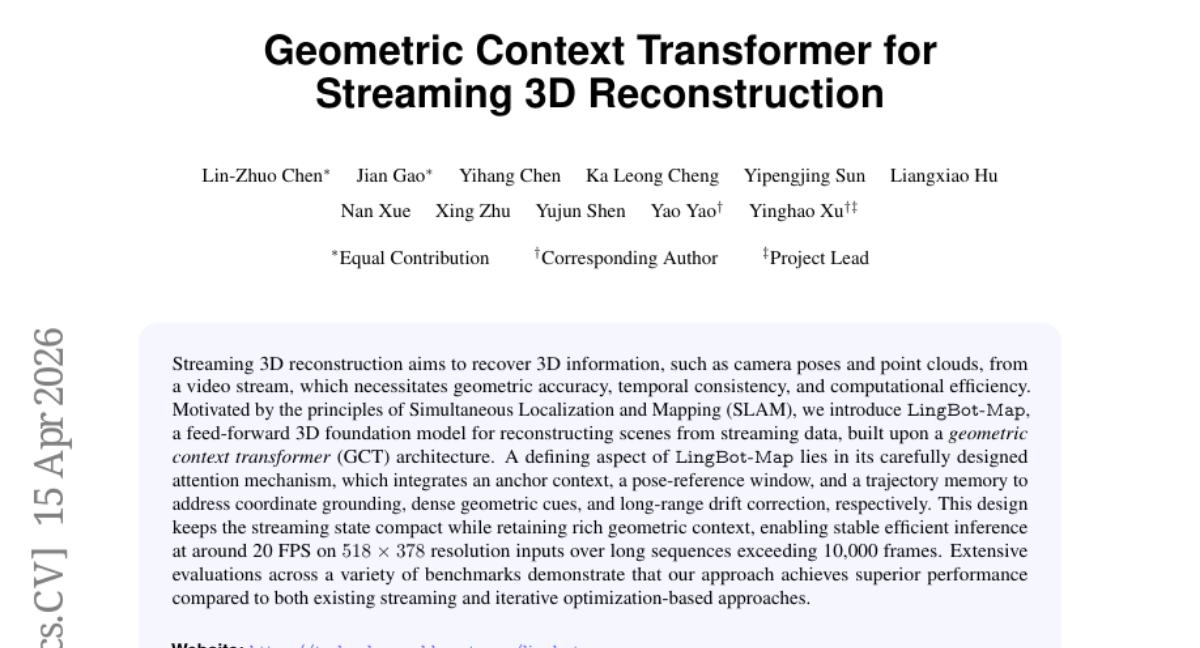
What It Is
LingBot-Map is a feed-forward 3D foundation model for streaming 3D reconstruction developed by Robbyant (Ant Group's embodied AI division). Announced April 15-16, 2026, it enables real-time spatial understanding from continuous video streams using only a standard RGB camera.
The key insight: LingBot-Map proves streaming reconstruction can outperform offline methods—breaking the assumption that real-time processing sacrifices accuracy.
Unlike traditional 3D reconstruction methods that process complete image sets offline, LingBot-Map operates on a "see-as-you-go" principle. It continuously estimates camera position and reconstructs 3D structure frame-by-frame as video is captured.
Technical Architecture
Geometric Context Transformer (GCT)
The core innovation is Geometric Context Attention (GCA)—a novel attention mechanism inspired by classical SLAM principles that selectively manages geometric context:
| Context Type | Function |
|---|---|
| Anchor Context | Coordinate and scale grounding—prevents drift |
| Pose-Reference Window | Dense visual features from recent frames |
| Trajectory Memory | Compressed tokens encoding full observation history |
Why GCA Matters
| Approach | Problem |
|---|---|
| Global Attention | Infeasible for streaming (requires all data upfront) |
| Causal Attention | Linear memory growth |
| Sliding Window | Loses long-term context, causes drift |
| GCA (LingBot-Map) | ~80x memory reduction, bounded per-frame cost |
Model Pipeline
- ViT Backbone (DINOv2-initialized) encodes input images
- Tokens augmented with camera token, register tokens, learnable anchor
- Alternating Frame Attention + GCA layers
- Camera Head → absolute pose prediction
- Depth Head → depth map prediction
Key Specifications
| Parameter | Value |
|---|---|
| Resolution | 518x378 pixels |
| Speed | ~20 FPS |
| Max Sequence | 10,000+ frames with stable accuracy |
| Model Size | 4.63 GB checkpoint |
| License | Apache 2.0 |
| Backbone | ViT (DINOv2-initialized) |
| GitHub Stars | 2.6k+ (rising) |
Benchmarks
Oxford Spires (Large-scale outdoor)
| Method | Type | AUC@15 | ATE (m) |
|---|---|---|---|
| LingBot-Map | Streaming | 61.64 | 6.42 |
| DA3 | Offline | 49.84 | 12.87 |
| VIPE | Offline | - | 10.52 |
| CUT3R | Streaming | 5.98 | 18.16 |
Key Finding: 2.8x improvement in trajectory accuracy over previous best streaming method. Beats offline methods despite real-time constraints.
ETH3D (Reconstruction Quality)
| Method | F1 Score |
|---|---|
| LingBot-Map | 98.98 |
| Second-best | 77.3 |
| Gap | +21.65 points |
Long-Sequence Stability
- LingBot-Map maintains nearly constant accuracy across 3,840 frames
- Competitors degrade significantly over time
Competitor Comparison
vs. Streaming Methods
| Method | Limitation | LingBot-Map Advantage |
|---|---|---|
| CUT3R | Aggressive compression → state forgetting | Selective context retention |
| StreamVGGT | Near-complete history → memory/computation growth | Bounded per-frame cost |
| Spann3R | Limited long-sequence robustness | 10,000+ frame stability |
vs. Offline Methods
| Method | Oxford Spires ATE |
|---|---|
| LingBot-Map (Streaming) | 6.42m |
| DA3 (Offline) | 12.87m |
| VIPE (Offline) | 10.52m |
LingBot-Map outperforms offline batch processors while running at 20 FPS.
Community Sentiment
Pros
- Real-time 20 FPS—practical for deployment
- Outperforms offline methods—no accuracy tradeoff
- Apache 2.0 open-source—fully accessible
- Single RGB camera—no depth sensor required
- 10,000+ frame stability—long-sequence robustness
Concerns
- 4.63GB model size—requires significant GPU memory
- CUDA 12.8 + PyTorch 2.9.1 dependency—specific version requirements
- 518x378 resolution—relatively low input resolution
- New release—limited real-world deployment validation
Use Cases
- Autonomous Navigation: Real-time spatial awareness for mobile robots
- Robotics/Embodied AI: Foundation for robotic companions, caregivers
- Augmented Reality: Real-time 3D mapping for AR devices
- Autonomous Vehicles: Continuous spatial perception
- Game Development: AI-generated world maps, level prototypes
Why It Matters
1. Paradigm Shift
Streaming reconstruction can outperform offline methods. Real-time doesn't mean compromise.
2. Infrastructure Layer for Embodied AI
This fills a critical gap: continuous, stable 3D spatial understanding from live video. It's the "real-time 3D reconstruction layer" enabling robots to navigate dynamic environments.
3. Strategic Open-Source Play
Ant Group/Robbyant is building a layered open-source stack:
- LingBot-Depth (depth sensing)
- LingBot-Map (3D reconstruction) ← NEW
- LingBot-World (world simulation)
- LingBot-VLA (robot control)
By open-sourcing under Apache 2.0, they're capturing infrastructure-layer value as embodied AI commercializes.
4. Technical Innovation
GCA replaces hand-crafted SLAM heuristics with end-to-end learned geometric context selection.
Summary
LingBot-Map achieves state-of-the-art performance on major benchmarks while maintaining 20 FPS streaming speed. Its Geometric Context Attention enables long-sequence stability without memory explosion. The Apache 2.0 release positions Ant Group to capture infrastructure-layer value as embodied AI commercializes.
Key Numbers:
- Oxford Spires ATE: 6.42m (2.8x improvement)
- ETH3D F1: 98.98 (+21 points)
- Speed: 20 FPS
- Sequence length: 10,000+ frames
- Model: 4.63GB (Apache 2.0)
Links: GitHub | arXiv | HuggingFace