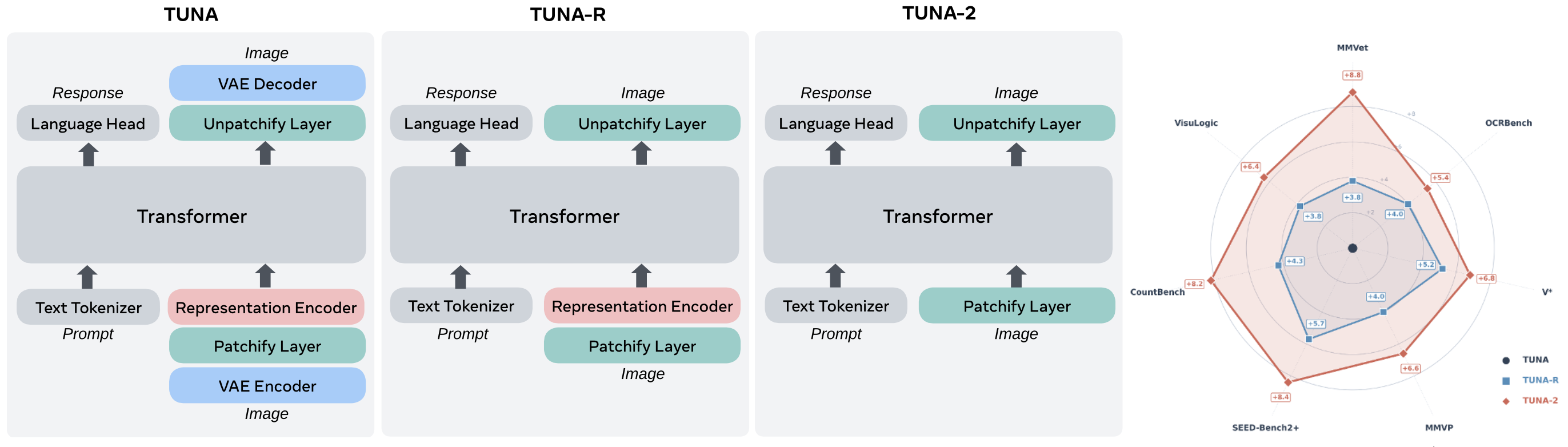
Meta Research just proved something the AI industry has questioned for years: you don't need pretrained vision encoders. Tuna-2, their latest unified multimodal model, achieves state-of-the-art performance using simple patch embeddings directly from raw pixels—no CLIP, no VAE, no pretrained vision towers.
The Architecture
Traditional multimodal models follow a "glue" pattern: a frozen CLIP encoder provides visual features, a projector maps them to LLM token space, and the LLM processes them as text. This works, but it creates an information bottleneck. CLIP was trained for image-text matching, not fine-grained perception. It misses details—text in images, object counts, spatial relationships.
Tuna-2 discards the encoder entirely. Raw image patches pass through linear embedding layers, same as text tokens. The model learns visual features from scratch, end-to-end optimized for both understanding and generation. For image output, it uses Pixel-Space Flow Matching instead of discrete VQGAN tokens (like Chameleon), preserving fine detail.
The Numbers
On pixel-centric benchmarks, Tuna-2 dominates:
- OCRBench: 61.2 vs Emu3's 58.5 vs Chameleon's 42.4 (+44% over Chameleon)
- CountBench: 62.4 vs Emu3's 55.6 vs Chameleon's 39.1 (+60% over Chameleon)
- MMVP (Perception): 60.5 vs Emu3's 54.0 vs Chameleon's 40.6 (+49% over Chameleon)
- MMBench: 64.5 vs Emu3's 62.1 vs Chameleon's 54.2
Generation quality? GenEval score of 58.5, rivaling dedicated diffusion models like Flux.1. Image reconstruction hits PSNR ~32.8.
Why It Matters
This validates "The Bitter Lesson" in multimodal AI. Specialized modules (VAEs, CLIP encoders) eventually get replaced by general-purpose architectures plus more data. Tuna-2's ceiling is higher because it learns visual features specifically tuned for its tasks, not borrowed from a frozen encoder trained on a different objective.
The trade-off: training tax. Without a pretrained encoder shortcut, Tuna-2 needs significantly more compute to reach baseline. But once scaled, the model has no architectural ceiling from encoder bottlenecks.
Community Take
Hacker News users see this as the final step in making multimodal AI as clean as pure text models—no more "vision tower" architecture. r/LocalLLaMA is split: celebratory about the performance gains, skeptical about the compute requirements for anyone without Meta's resources.
The real excitement? Robotics and embodied AI. Models that understand pixel-level coordinates—"which side is the cup on?"—matter more for real-world interaction than abstract CLIP semantics.
Sources
- Paper: https://arxiv.org/abs/2604.24763
- Project: https://tuna-ai.org
- Code: https://github.com/facebookresearch/tuna-2
- HuggingFace: https://huggingface.co/papers/2604.24763